
· A major breakthrough in safety, speed, efficiency and sustainability
The process of demolishing a building can be a task of varying complexity depending on its location, size and structure. The use of technology and skilled labour plays a key role in this type of work, particularly when undertaking large-scale projects of technical complexity such as the one INCOGA is currently carrying out in the very heart of Paris’s commercial district.
How have demolition techniques evolved in recent years?
Technological advances and the increasing professionalism of the workforce have brought about a turning point in this construction process. Their introduction has led to an exponential improvement. Today, we have a wide range of techniques and solutions at our disposal – from the most basic to the most sophisticated – which we can draw upon, and even combine, depending on the characteristics and requirements of each project.
What are the advantages of technical demolition methods over traditional ones?
The main advantage is, without a doubt, safety. Technical demolition is carried out using remote-controlled equipment, which allows the operator to work at a distance from the area being treated and without the need for physical exertion, thereby minimising the risk of injury.
Furthermore, this approach increases output and reduces completion times, thereby boosting productivity and, consequently, efficiency and profitability.
Furthermore, state-of-the-art robotic machinery is so sophisticated that it enables ‘surgical’ work of extreme precision, which would be unfeasible in traditional demolition.
In this type of demolition, noise levels, as well as the generation of dust and rubble, are significantly lower.
When is each one used?
At INCOGA, when planning a demolition project, we analyse various factors such as its scale, location and the materials to be demolished in order to select bespoke solutions that optimise both the processes and the end result.
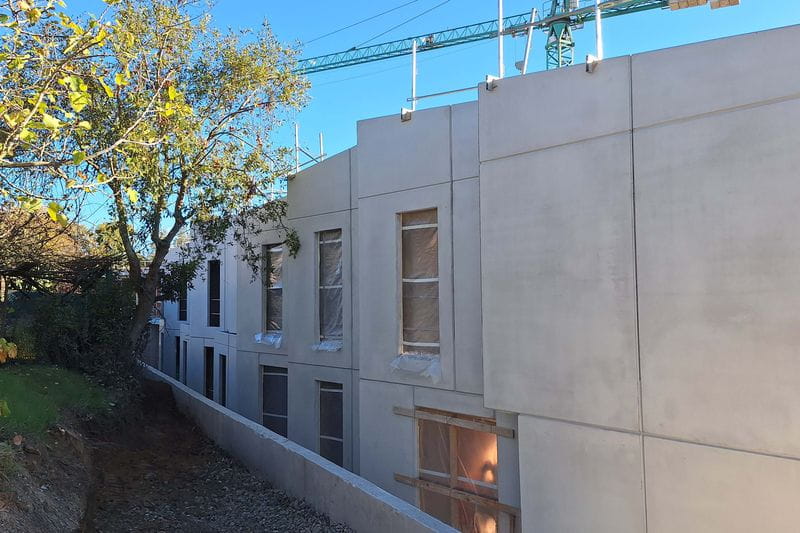
INCOGA is currently carrying out a project to refurbish, extend and structurally renovate a commercial premises covering more than 4,500 m², located in the centre of the French capital, using state-of-the-art demolition solutions and machinery.
What are they, and what does each one involve?
As this is a large-scale project, located in the town centre and involving a variety of materials and structures, we are carrying out various types of technical demolition work.
One of these involves using a wall saw to cut openings in stone and concrete structures, which will house lifts, staircases, doors or windows. The saw consists of an electric or hydraulic head supporting a diamond blade, mounted on guides along which the cut is made. The main advantage of this method is that it allows us to work in any direction or at any angle, as well as making flush cuts and cuts through non-uniform sections, without the risk of cracks or vibrations.
We are also introducing diamond wire cutting, a technique very similar to the one described above, in which the conventional cutting disc is replaced by a diamond wire tool that allows cuts of various shapes and sizes to be made without restriction.
For large-diameter drilling, we use diamond core drills, a solution that stands out for its cost-effectiveness and precision.
Finally, as a replacement for traditional manual demolition work, we use various demolition robots that offer high power and precision. These enable us to significantly reduce project timelines and maximise safety for the team and the surrounding area.
INCOGA is a company that is committed to sustainability and innovation as core corporate values. In this regard, and in relation to demolition work, what initiatives is the company undertaking in this specific project?
We have state-of-the-art machinery specialised in the effective and efficient management of waste and on-site recycling, such as plasterboard and brick crushers, or crushers for more resistant materials, such as concrete or concrete blocks.
By sorting, managing and giving waste a new lease of life, we contribute to the circular economy as part of our commitment to sustainability and our dedication to the environment.