
Why choose an industrialised envelope for a premium residential complex of single-family homes? When the goal is to raise the standard of execution with dimensional precision, quality control and more predictable deadlines, industrialisation allows the façade to be converted into a planned and traceable process with a high degree of accuracy, without sacrificing a top-level architectural finish.
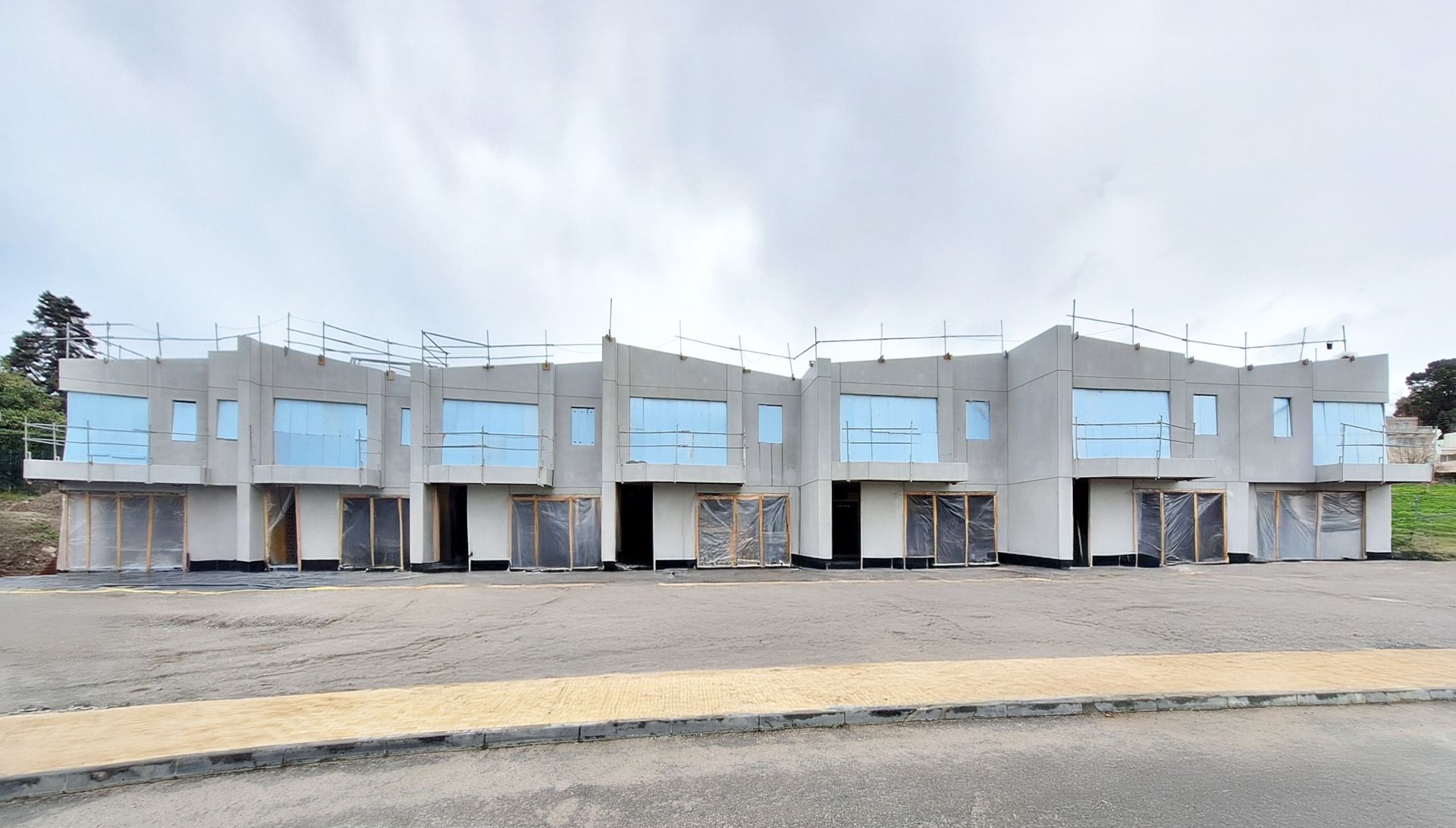
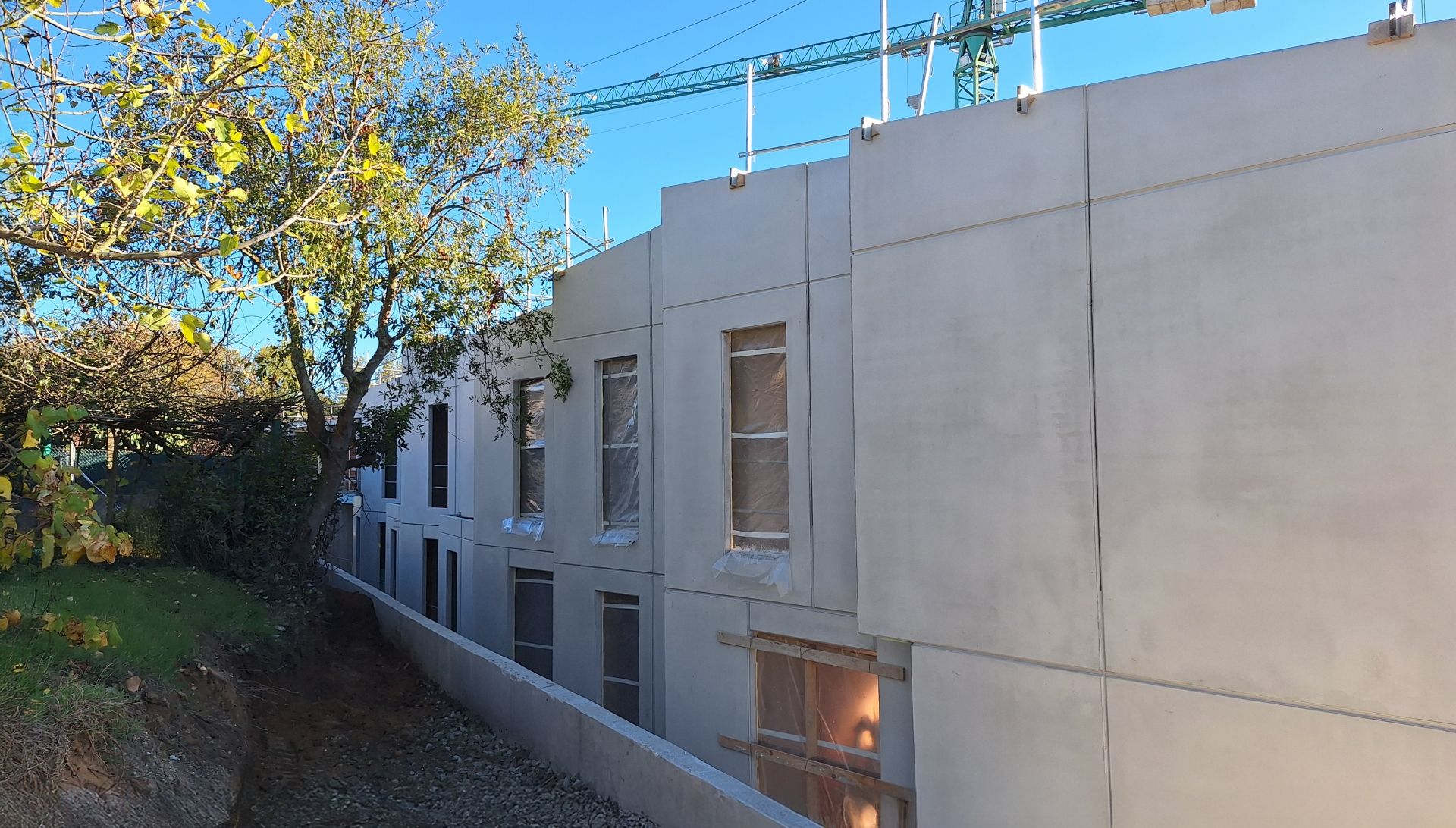
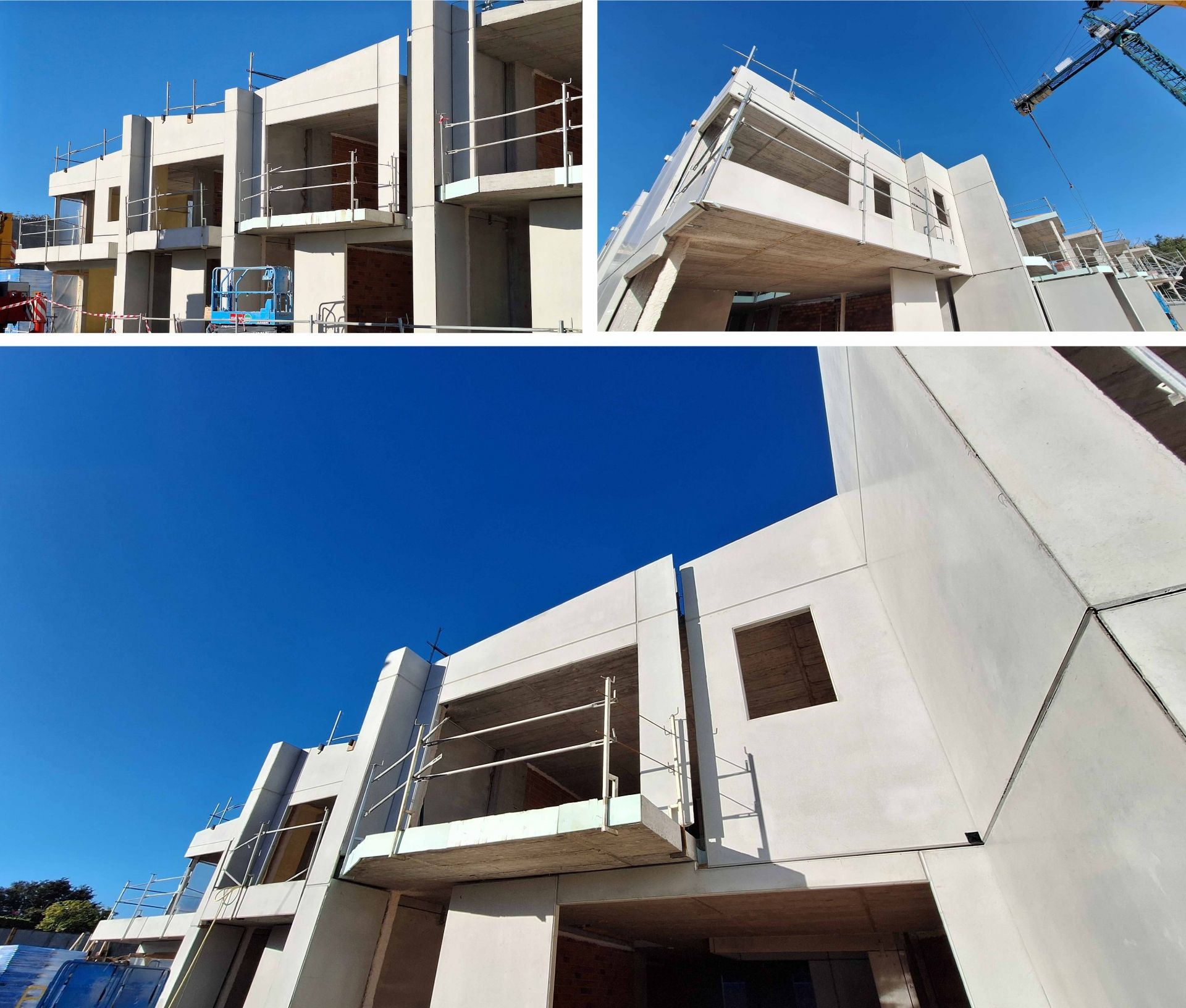
In this case study, we describe, step by step, how INCOGA executed the envelope of Icaria Point using prefabricated architectural exposed concrete panels, focusing on on-site assembly and the critical points that make the difference between a correct installation and an excellent result.
Context and objectives
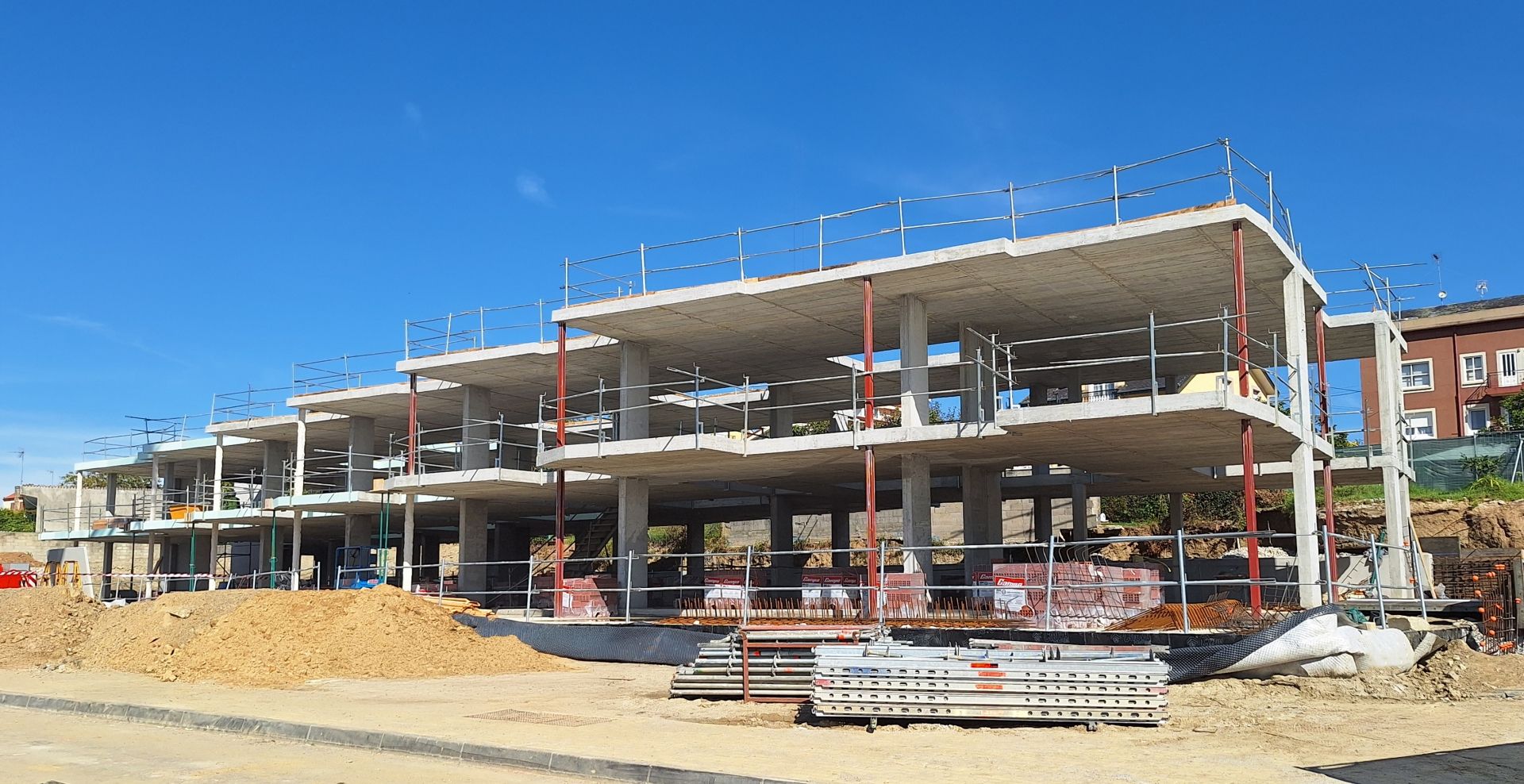
Currently under construction, Icaria Point is a private residential development located in one of the most prestigious and sought-after residential areas in the region of A Coruña. The project consists of seven premium homes of different types, with private green areas and communal areas with green spaces and a swimming pool. With a built area of over 2,000 m², Icaria Point stands out for its cutting-edge architectural design and the incorporation of state-of-the-art technological and sustainable solutions: aerothermal energy, geothermal energy, underfloor heating and home automation, designed to optimise energy efficiency, ensure consistent thermal comfort and facilitate smart home management.
The project uses a palette of noble and sustainable materials, such as wood, steel and prefabricated exposed concrete, which combine durability, low maintenance and timeless aesthetics. The building envelope and construction details have been designed to enhance thermal and acoustic performance, reinforcing interior comfort and quality of use on a daily basis.
At Icaria Point, the objective was to create a high-quality architectural envelope with:
- Maximum control over the finish of exposed architectural concrete.
- Dimensional precision to ensure accurate joints, seams and alignments.
- Reduced interference on site and greater predictability of deadlines.
- Safe and orderly execution through a planned lifting and placement process.
How was it done? On-site assembly process, phase by phase
The process is described below, from the delivery of the panels to the site to the treatment of joints, including the critical points prioritised to ensure an optimal result.
1) Advance planning
Although the assembly begins with the reception, the result is defined in advance through detailed, precise and meticulous planning that takes into account:
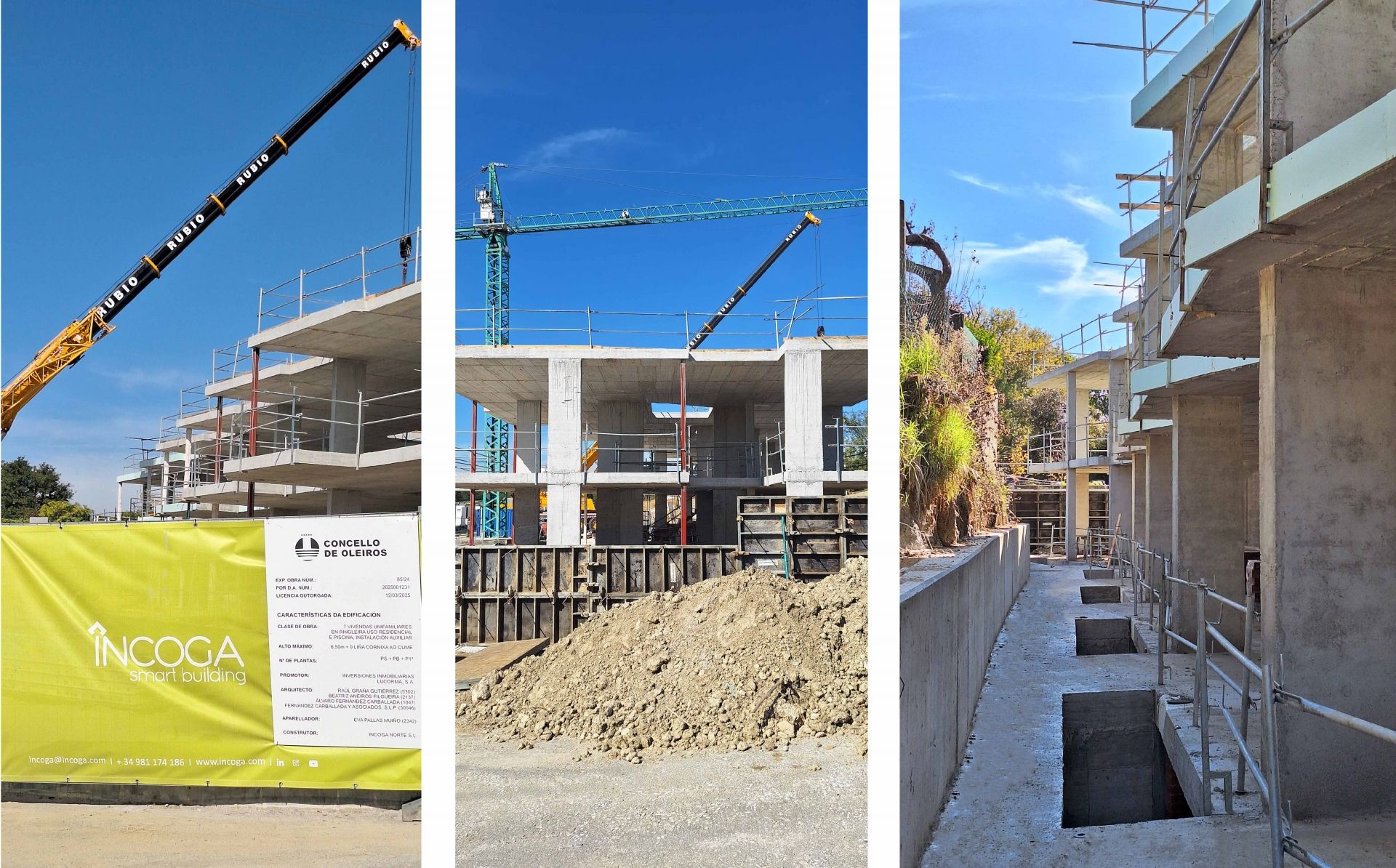
- Lifting and handling plan: working radii, crane capacities, placement sequence and collection points.
- Definition of tolerances and references: layout, control dimensions and verification points for plumb lines, levels and alignments.
- Logistical coordination: unloading windows, accesses, internal routes and safety zones.
- Fixing and support points: checking that the receiving structure and anchoring elements are ready to receive panels, avoiding rework.
Industrialised assembly requires that the work be in optimal condition prior to the start of the assembly process, with closed layouts and preliminary checks carried out.
2) Reception and entry control
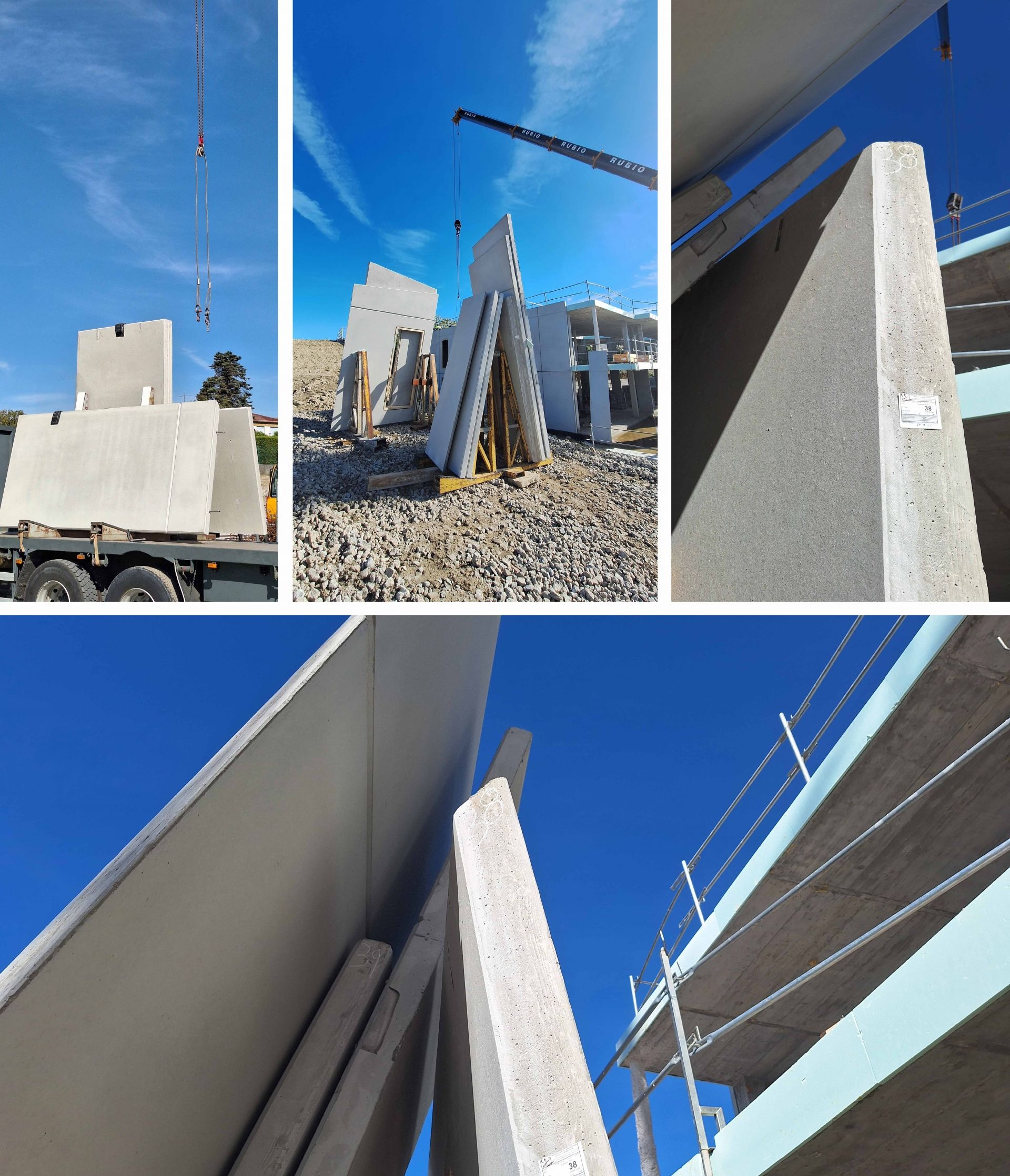
After the prefabricated elements arrive on site, a quality control check is carried out in the field:
- Document verification: identification of parts, assembly sequence, lifting/handling instructions and supply traceability.
- Visual inspection of finish: review of exposed concrete (edges, exposed faces, possible transport marks) and checking the condition of protective covers.
- Checking of fittings and lifting inserts: lifting points and auxiliary elements in accordance with the provisions for safe lifting.
At this stage, protecting the finish is crucial. Interaction with slings, tools and supports must be carefully managed to avoid scratches, chips or marks.
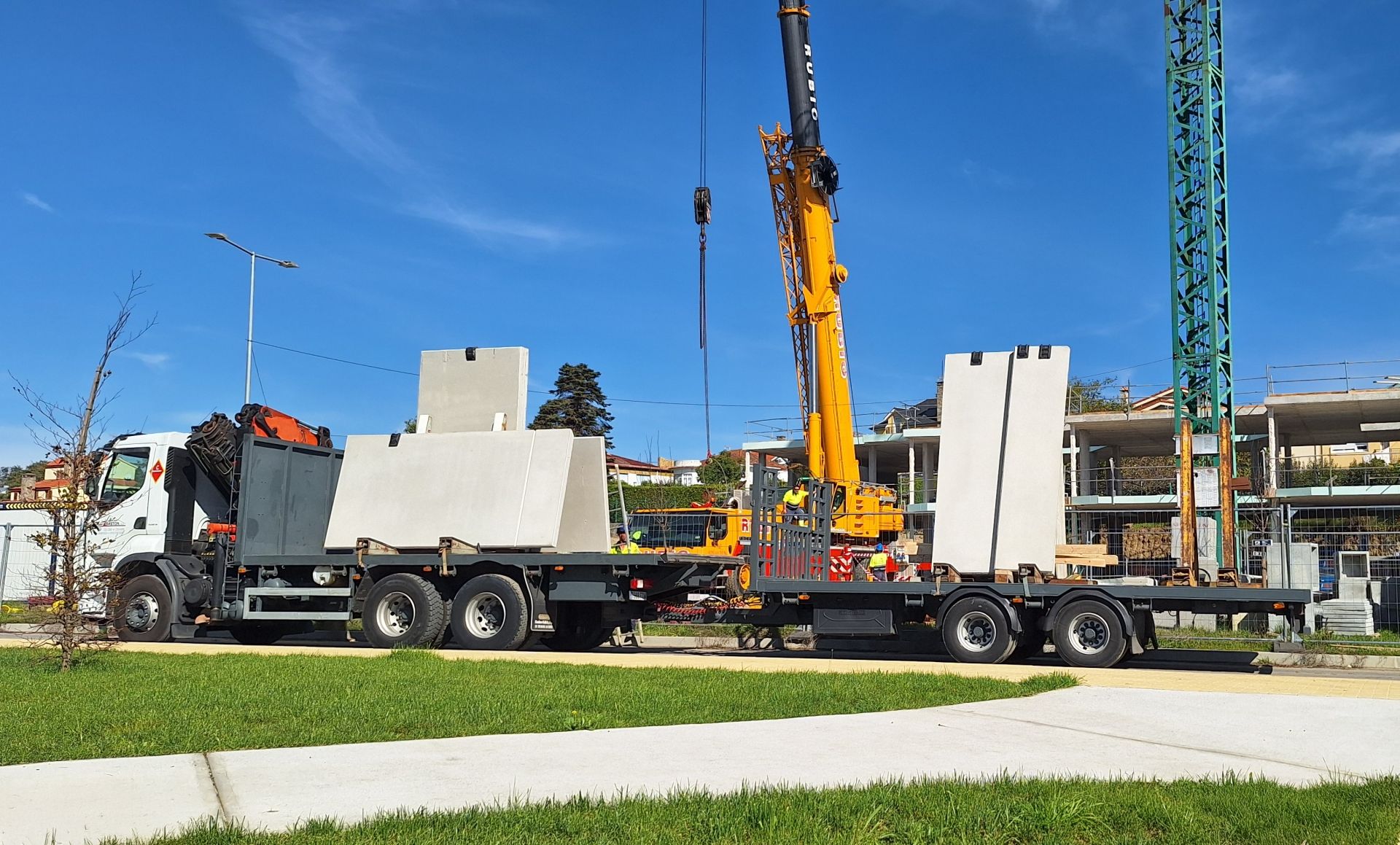
3) Unloading, temporary storage and preparation for manoeuvring
Before proceeding with the hoisting, the preparation area on site is organised:
- Controlled storage: suitable support surfaces, separation of edges and stability to prevent tipping or stress.
- Assembly of tools: slings, balancers or specific accessories depending on the geometry and weight of the panel.
- Safety briefing and roles: signalman, guidance operator, crane operator and assembly team aligned in sequence.
Industrialisation reduces uncertainty and raises the standard of coordination. A well-defined manoeuvre avoids waiting, unnecessary movements and rework.
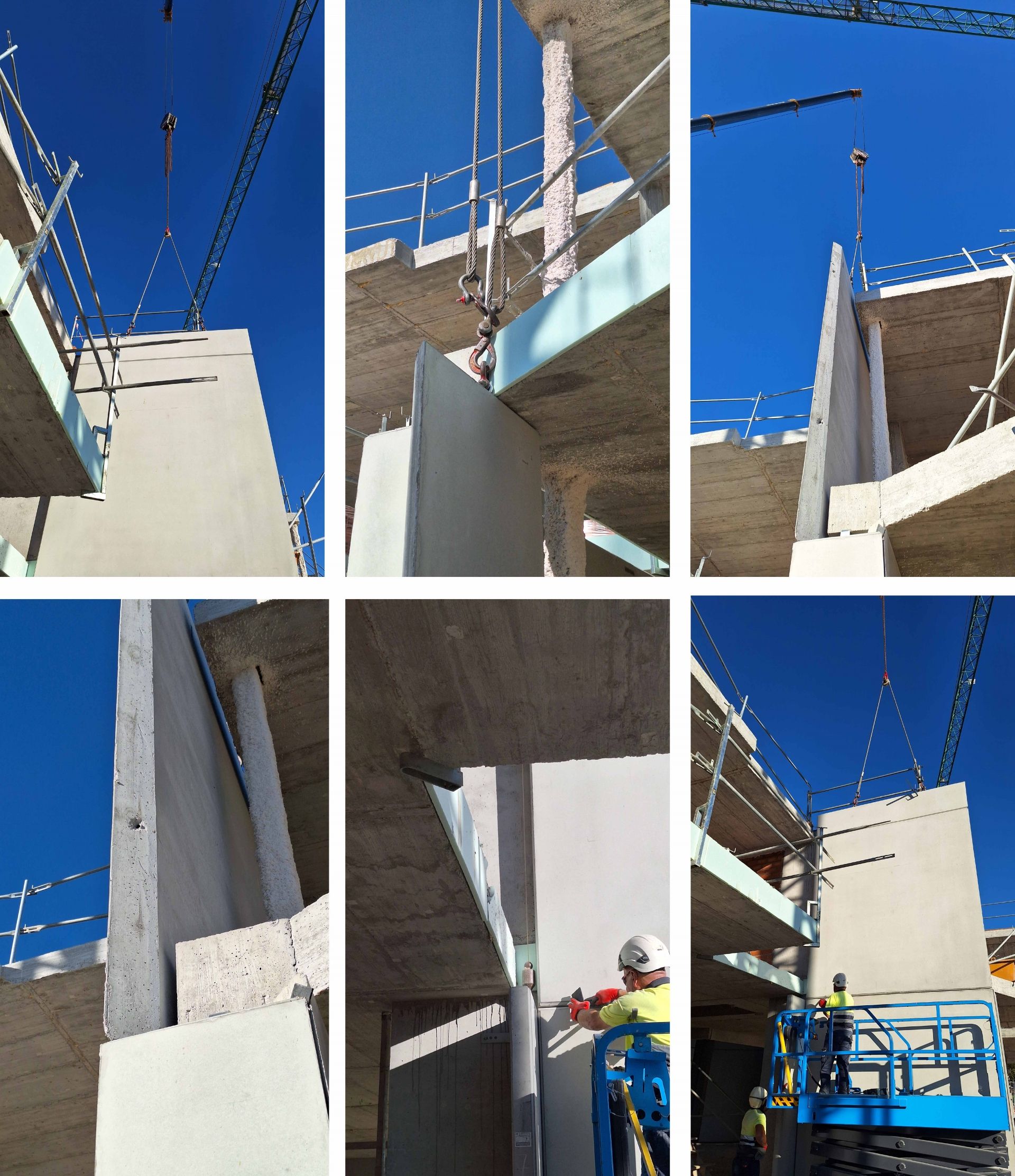
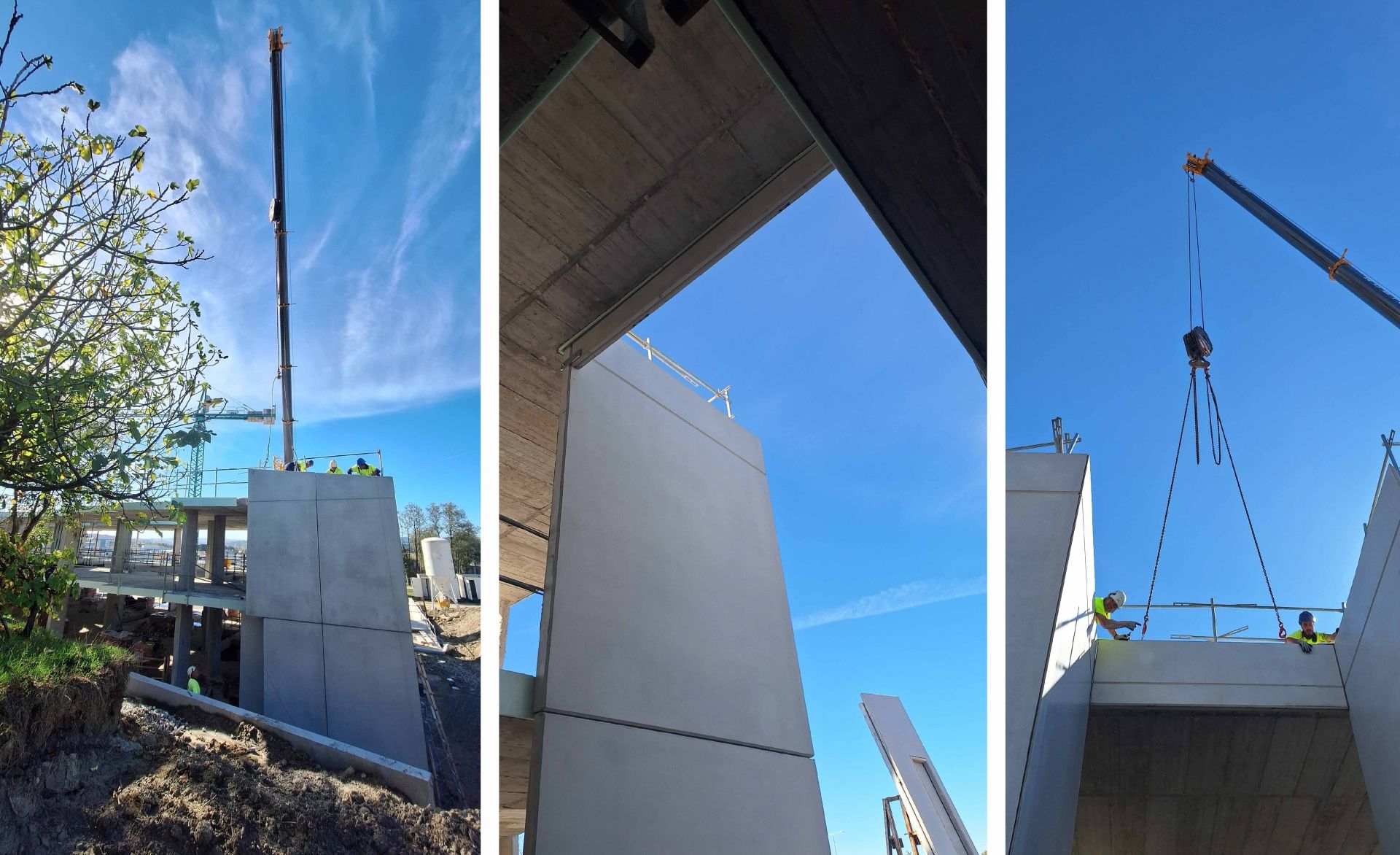
4) Lifting with a mobile crane and fine positioning
This is the critical phase in terms of precision:
- Controlled lifting: progressive movements, avoiding twists and oscillations.
- Guidance and approach: the panel approaches its position while maintaining a safe distance from edges and singular points.
- Alignment with references: plumb control, levelling and adjustment to layout dimensions.
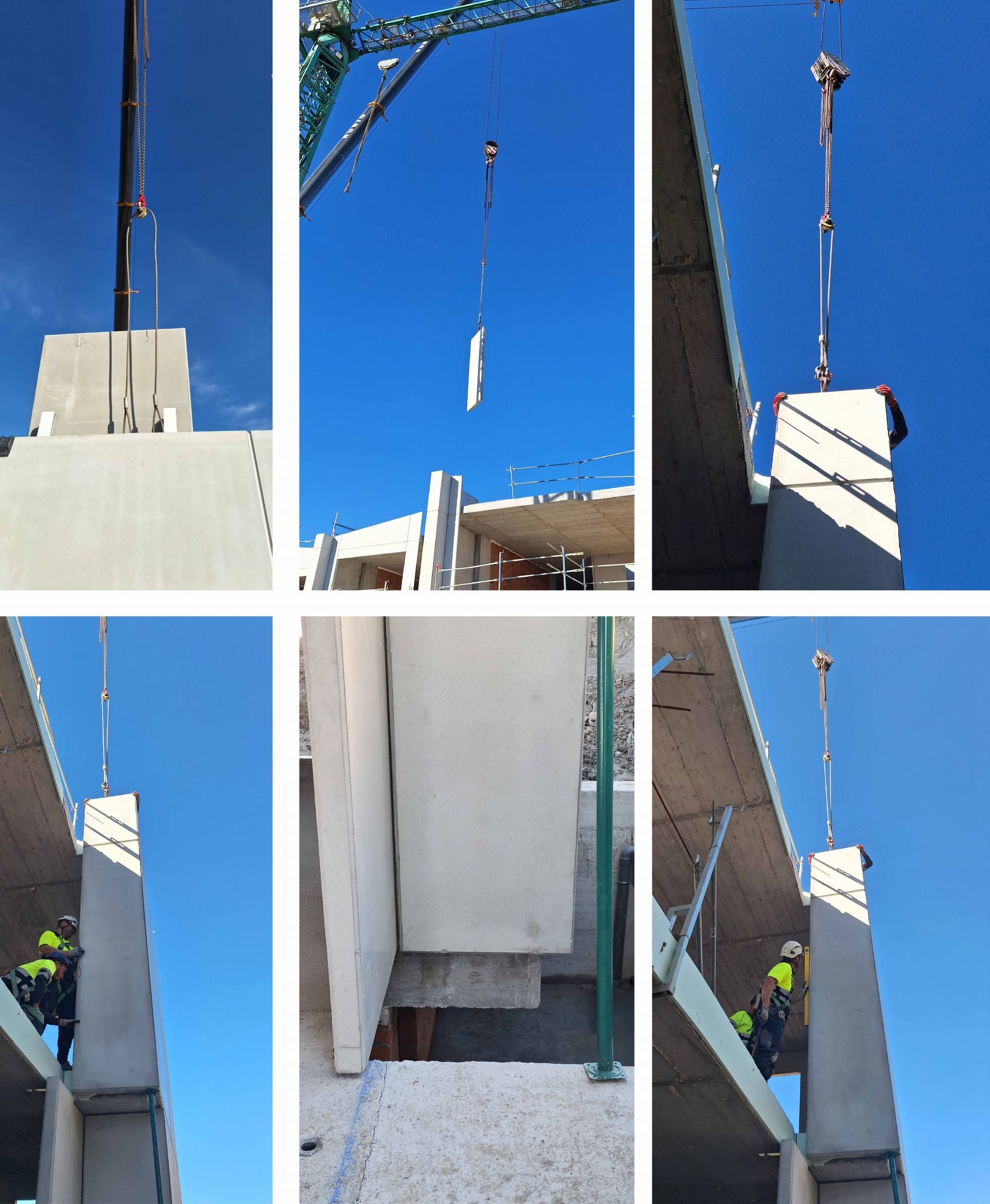
The precision of prefabrication can only be achieved if positioning and reception in the structure are carried out with systematic controls. In industrialisation, it is not enough to ‘approximate’; assembly must be carried out to tolerance.
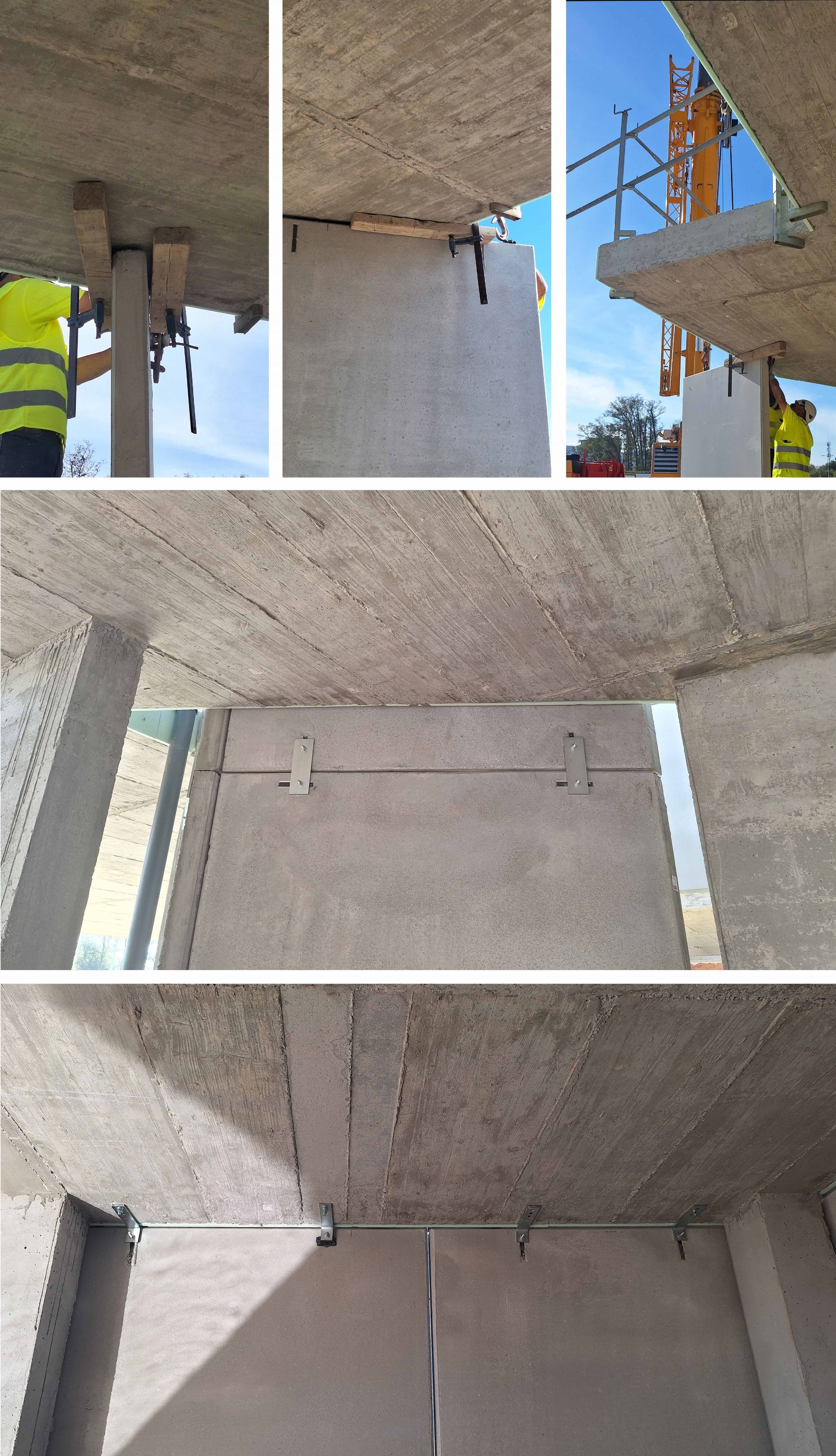
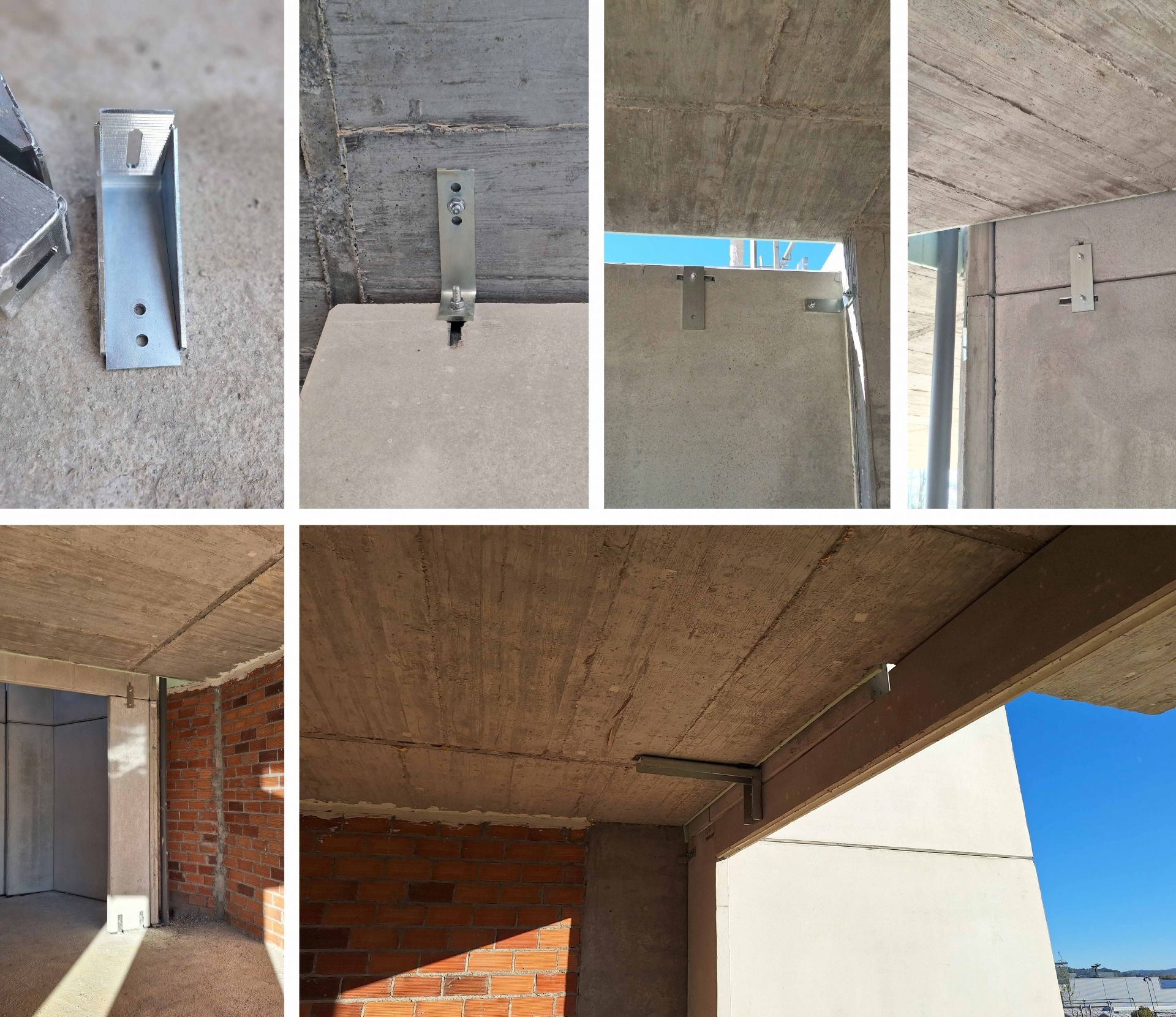
5) Fixing and stabilisation: anchors and temporary fastenings
Once in position:
- Fixing to receiving elements according to the project, with anchors and supports provided.
- Temporary stabilisation (provisional bracing) where appropriate, to ensure safety until the assembly and final points are completed.
- Verification of plumb lines and alignments after fixing.
Securing the panel correctly before releasing the lift prevents unwanted stress and protects both the part and the structure.
6) Treatment of joints, connections and final inspection
The closure of the envelope does not end with the installation of the panels.
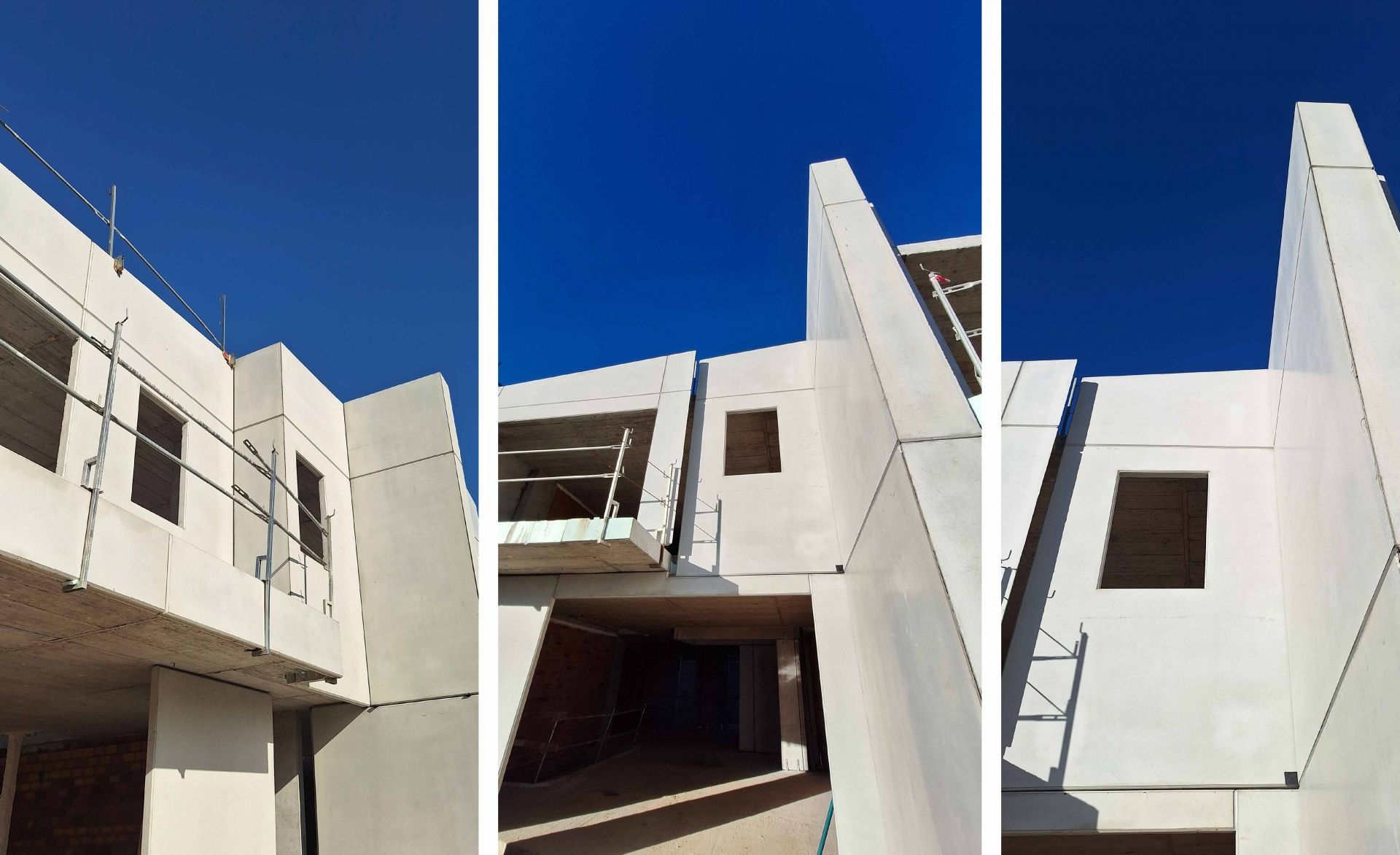
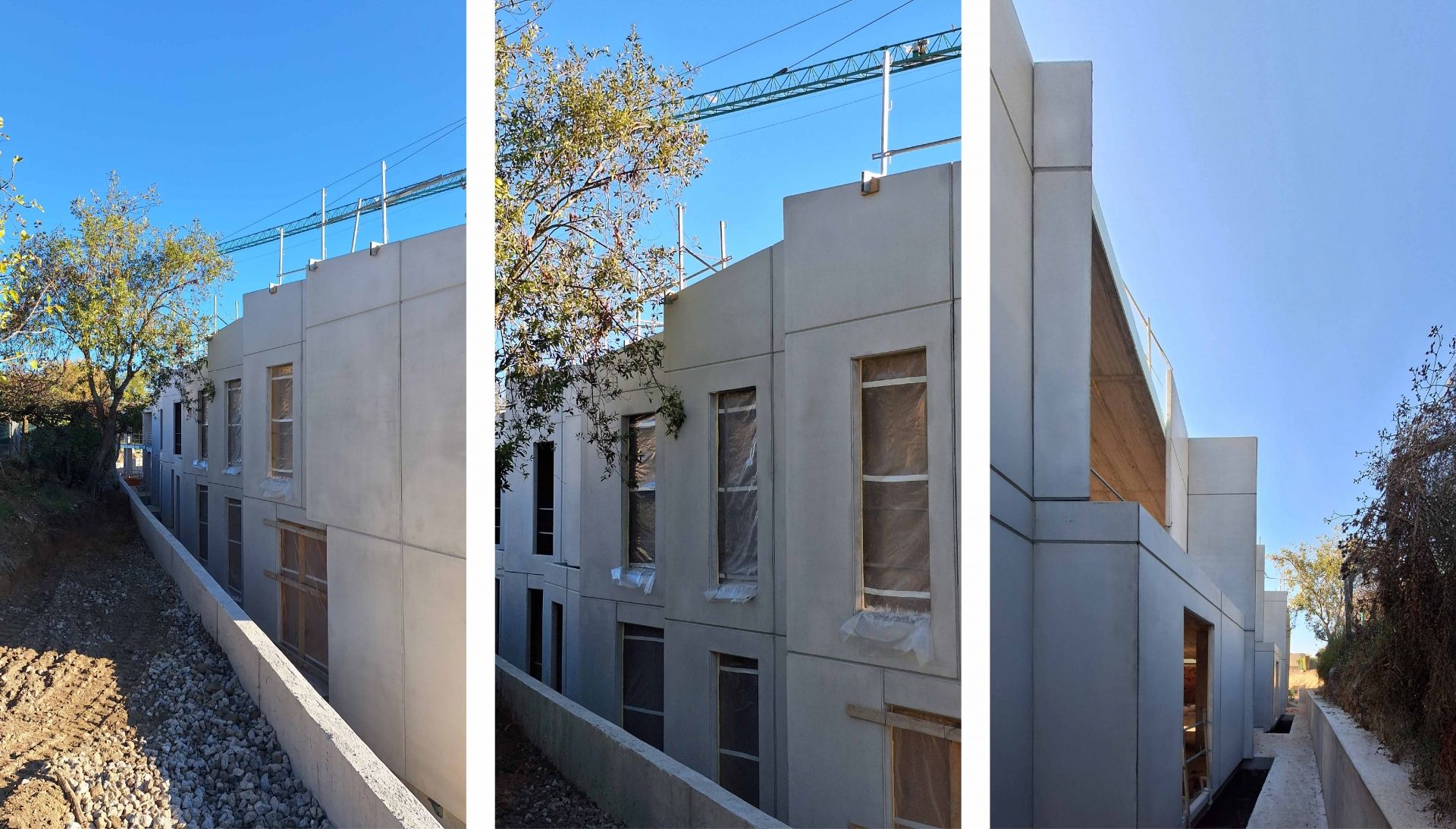
- Geometric control of the fabric: continuity of alignments, modulation and regularity of joints.
- Execution of joints and seals according to specifications: watertightness, leakage control and durability.
- Final finish inspection: technical cleaning, removal of protective coverings and visual verification of exposed concrete.
The envelope is a system. Thermal, acoustic and airtightness performance depends both on the quality of the panel and on the treatment of joints and connections.
Benefits of industrialised cladding compared to traditional solutions
Opting for prefabricated exposed concrete panels in a project such as Icaria Point offers clear advantages:
1) Architectural finish under industrial control
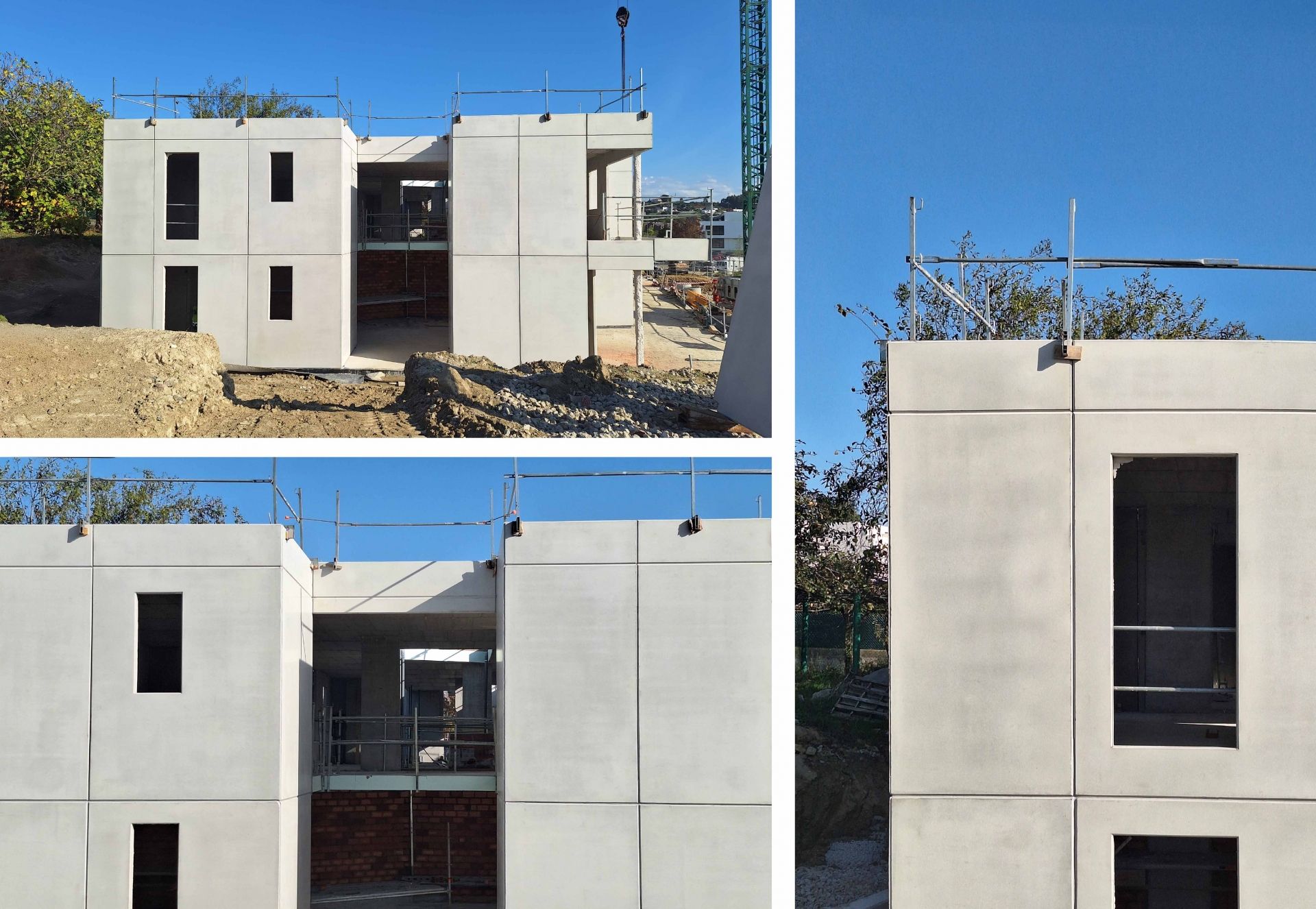
- Production in an industrial environment with standardised processes and systematic quality control.
- Greater colour and texture uniformity of exposed concrete, with defined tolerances and acceptance criteria.
- Less sensitivity to site conditions (weather, interference between trades and availability of resources), preserving the architectural finish.
2) Certainty of deadline and assembly productivity
- The façade is constructed as an assembly operation with a planned sequence and stable performance.
- Reduction of highly variable on-site work (formwork, treatments and finishing touches), reducing uncertainty and rework.
3) Less interference on site and greater operational efficiency
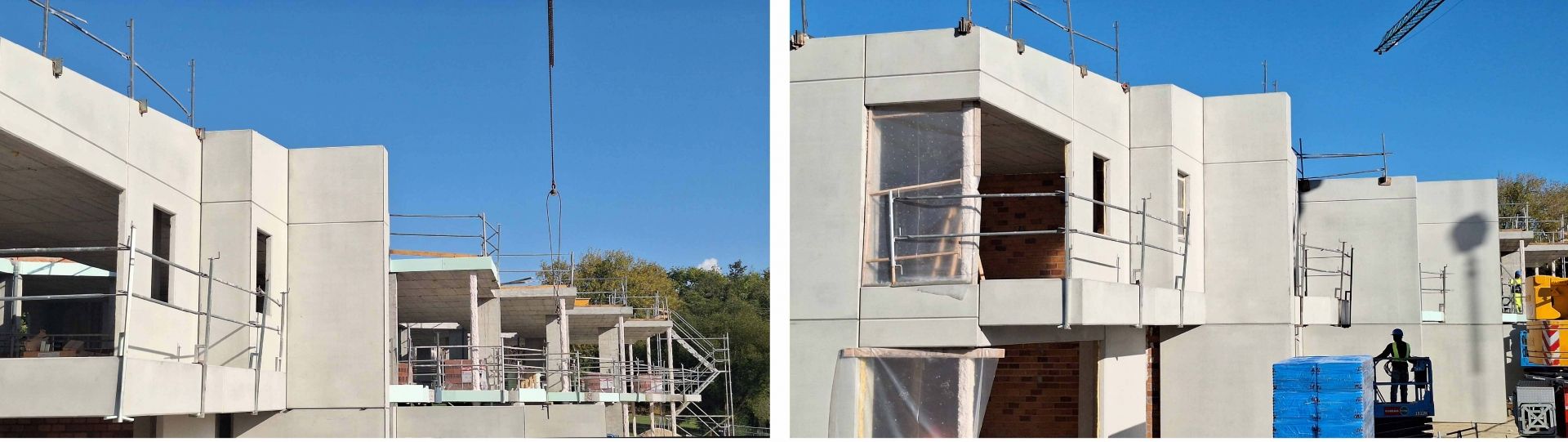
- Reduction in simultaneous activities on the façade, facilitating the coordination of tasks and continuity of production.
- More orderly and cleaner worksite: less stockpiling, less handling of materials and reduction in waste, with a direct impact on productivity and safety.
4) Performance, durability and behaviour of the envelope
- Highly durable, low-maintenance material, aligned with premium building standards.
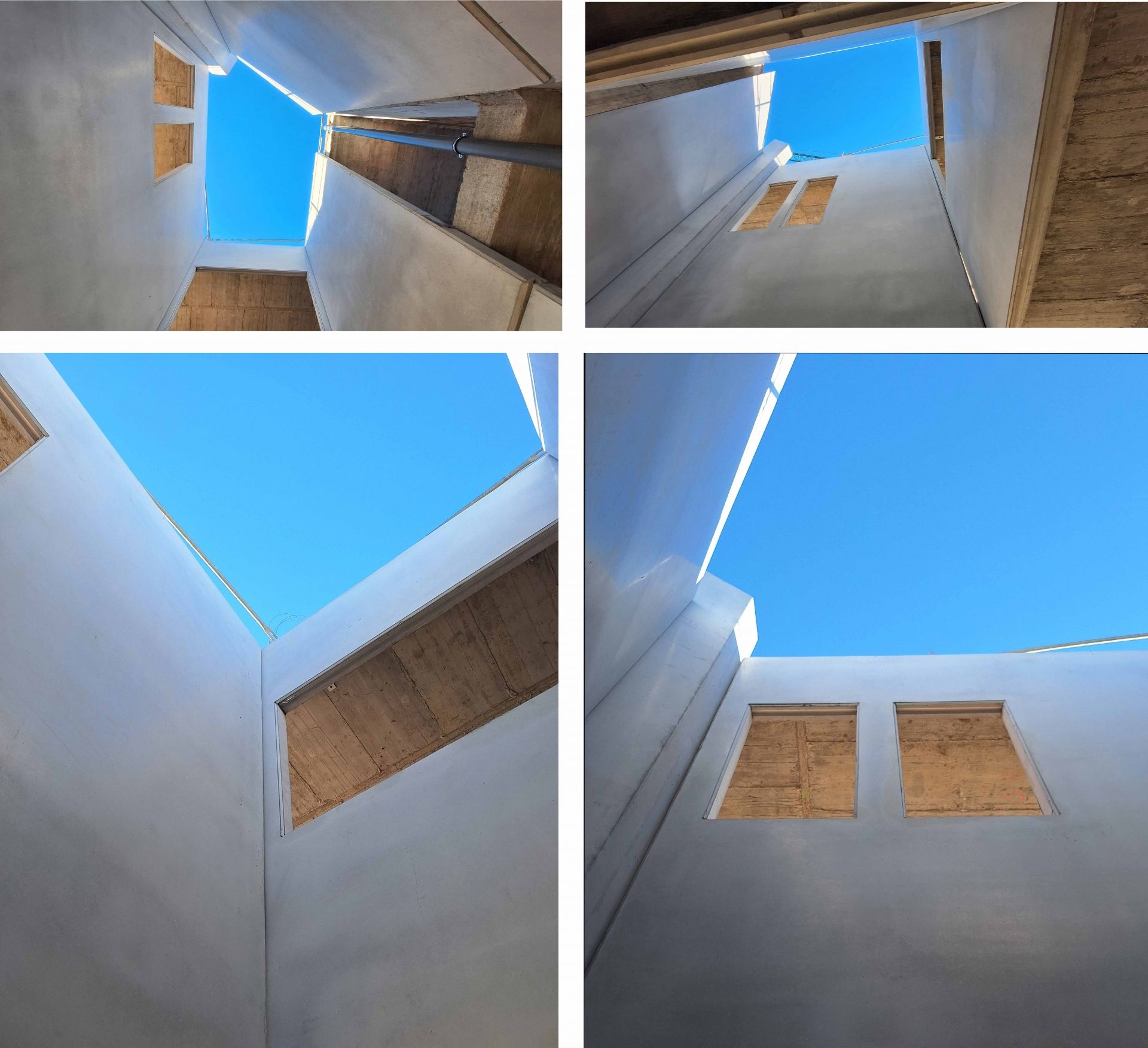
- Geometric precision that improves control of joints and seams, enhancing the overall performance of the system (watertightness, infiltration control and hygrothermal behaviour) when seals and details are executed according to specification.
5) Safety and risk control
- Lifting and assembly under defined procedures (manoeuvring plan, roles, lifting points), reducing improvisation in a high-risk phase.
- Less exposure to prolonged work at height and to ‘artisanal’ operations with greater uncertainty, improving preventive control.
6) Sustainability and resource efficiency
- Less impact on construction sites due to reduced wet work, cutting and waste on site, with more controlled assembly.
- Optimisation of consumption and use of materials in industrial manufacturing, with better traceability and control of deviations.
- Life cycle advantages: durability and low maintenance, reducing repair and replacement needs.
- Contribution to energy performance when integrated with the insulation system and joint sealing, improving watertightness and reducing infiltration losses.
Purposeful industrialisation, INCOGA seal
The execution of the industrialised envelope at Icaria Point confirms INCOGA's clear commitment to cutting-edge construction when it adds real value. Industrialisation is not just about changing the method; it is about raising the standard in terms of quality, precision, sustainability and deadline control, especially in projects where architectural and performance requirements are at their highest.
In this context, the prefabricated exposed concrete envelope is not merely a formal choice: it is a decision consistent with a technologically advanced and responsible construction model, aimed at delivering efficient, durable and future-proof homes.